Co-op Explained
Split Screen vs Shared Screen: 2 Stores, One Label for Both
Split screen vs shared screen: Xbox and Steam print one label for both, and Nintendo and PlayStation print neither. Only 24 of 270 games name split.
Most people read "Shared/split screen" on a store page as split-screen. For split screen vs shared screen, that label is no help: Xbox and Steam print it for both setups, and the store will not tell you which one you get.
TL;DR: Split-screen divides one TV into a view per player. Shared screen keeps everyone in one view. Online co-op gives each player their own screen and usually a membership. Xbox and Steam print one label for the first two; Nintendo and PlayStation print no screen field at all. Only 24 of the 270 games in our database name split-screen in a store description. Checked Oct 18, 2026.
As of Oct 18, 2026: player counts, labels and prices as the stores listed them that day. Stores change listings; the finder shows the latest check.
Verdict: Pick by the one-console count, not the screen label. Pick split-screen games when each player needs to roam. Pick shared-screen games for beginners. Skip online co-op for one TV. Store pages checked Oct 18.
Key Takeaways
- Three setups: split-screen (one TV, a view each), shared screen (one TV, one view), online co-op (a screen each, over the internet).
- One label, two meanings. Xbox's "Shared/split screen" and Steam's "Shared/Split Screen" cover both local setups. 163 games in our data carry one of them.
- Nintendo and PlayStation print no screen field. Nintendo prints Single system, Local wireless and Online; PlayStation prints a player count.
- Split-screen in words is rare: 24 of 270 games. Shared screen in words: 5.
- Memberships are for online play. PS Plus, Game Pass and Nintendo Switch Online gate online multiplayer, with exceptions such as free-to-play games on Xbox.
Overview
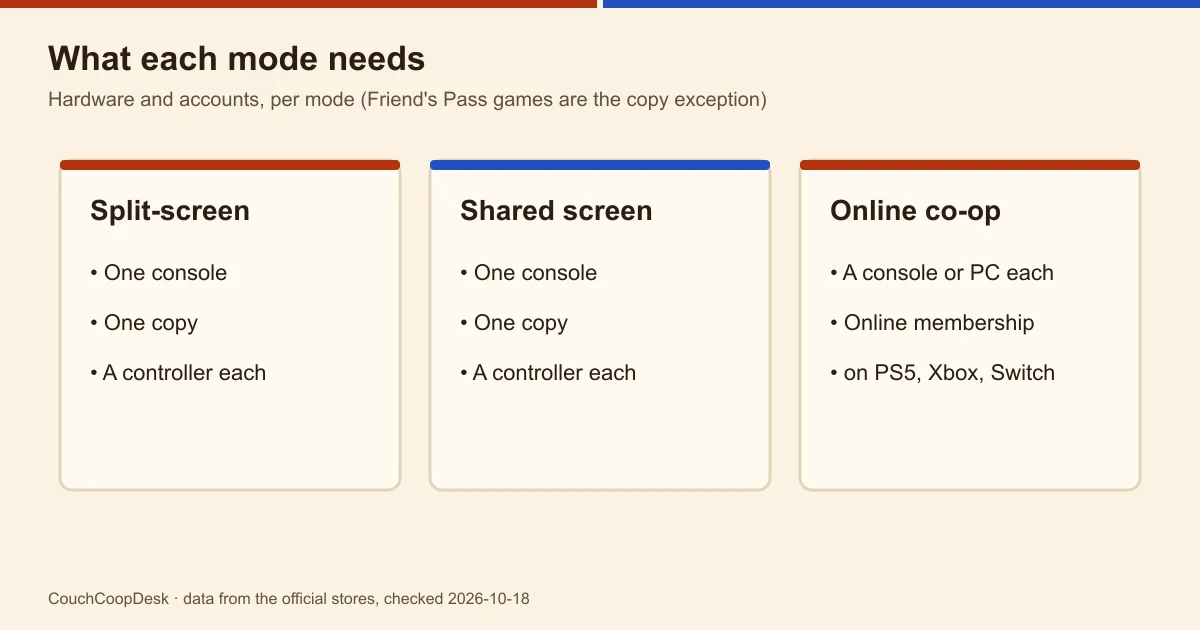 Diagram: CouchCoopDesk, from the store and support pages cited below, checked Oct 18, 2026.
Two people can play the same game three ways. Split-screen puts them on one TV, each with their own slice of it. Shared screen puts them on one TV in one view, so they have to stay close together. Online co-op gives each player a whole screen, on separate consoles or PCs, joined over the internet.
The first two are both "local" or "couch" co-op: one console, one copy, a controller each. The third is a different purchase. Usually both players need the game, and on consoles both need a membership.
Here is what each store actually prints:
| Store | Players on one console | Screen | Online |
|---|---|---|---|
| Microsoft Store (Xbox) | A range, such as "Xbox local co-op (2-2)" for Split Fiction, or a local multiplayer range | "Shared/split screen" label | "Online co-op (2-2)" on the same listing, plus crossplay labels |
| Nintendo | "Single system", such as "Single system (1)" for Stardew Valley on Switch 2 | No field | "Online (1-8)" on that listing, plus a "Local wireless" line |
| PlayStation Store | A count, such as "1 - 4 players" for Sackboy: A Big Adventure | No field | Online players, and whether PS Plus is required |
| Steam | A category, "Shared/Split Screen Co-op", no count | The same category | "Online Co-op", "LAN Co-op", "Remote Play Together" |
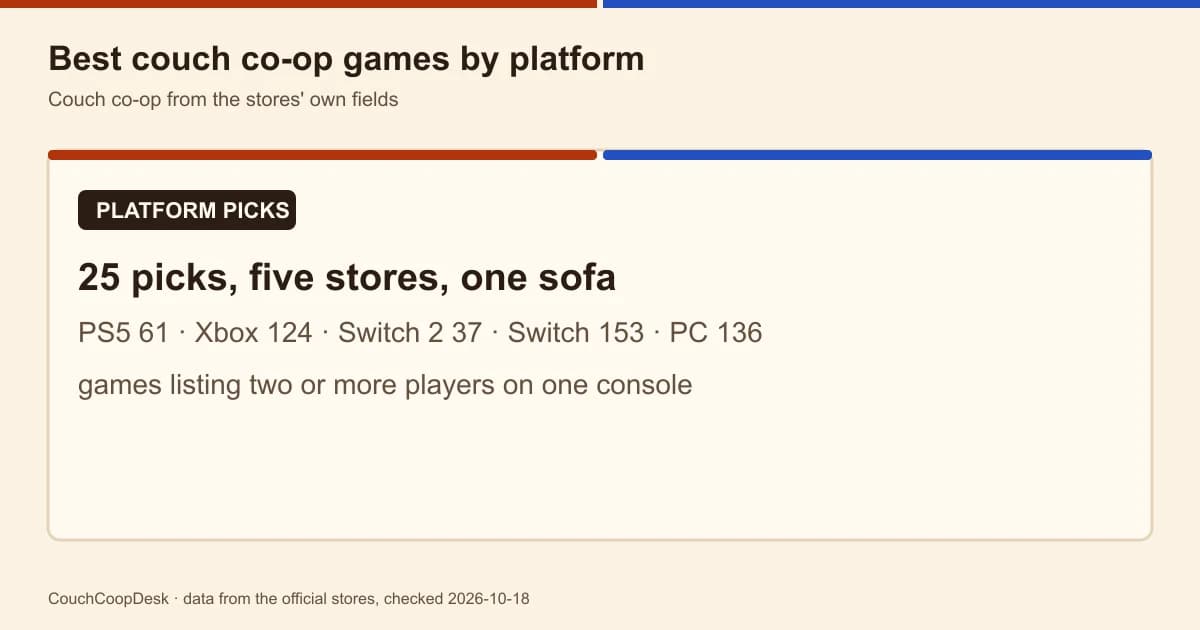
Same game, four stores, four vocabularies. Our best couch co-op games by platform guide picks games store by store with these fields.
Split screen vs shared screen: what the store labels mean
Split-screen and shared screen are both one-TV setups, and the stores mostly refuse to tell them apart. Xbox's label reads "Shared/split screen".
Steam's category reads "Shared/Split Screen". Either one tells you two people can play on one machine. Neither tells you how the picture is drawn.
That matters in practice. On a split screen, each player can wander off in their own direction, and each gets a smaller picture. On a shared screen, nobody can leave the frame, which keeps a group together and a beginner close to help. Four players listed, one TV, and somebody gets the small corner.
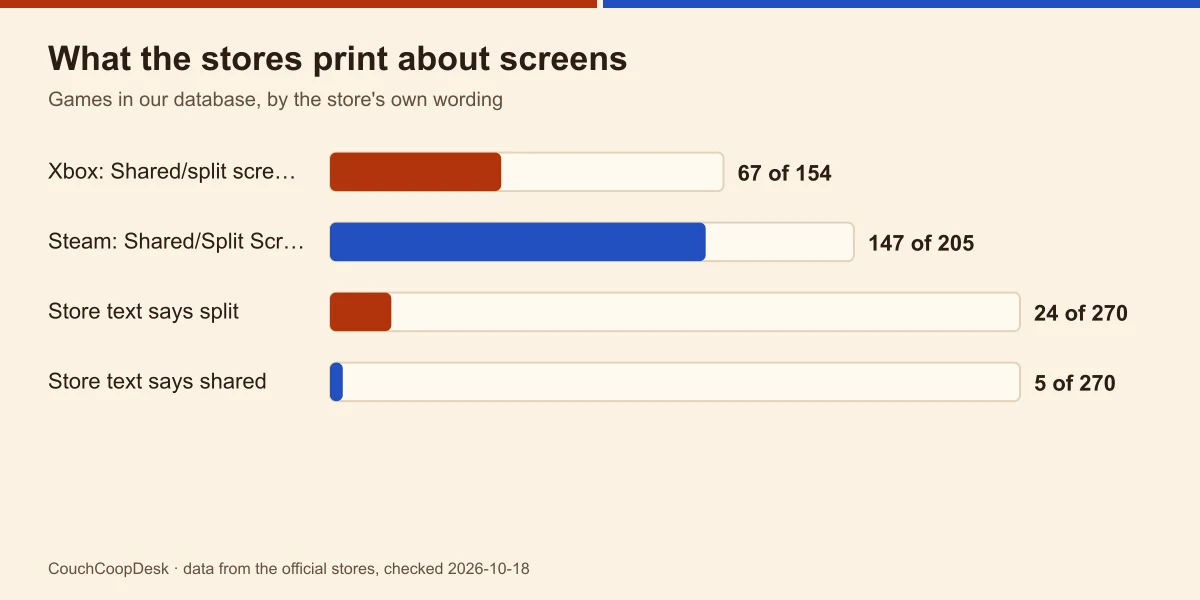 Chart: CouchCoopDesk, data from the official stores, checked Oct 18, 2026.
Only a store's own description, or the publisher, says which. In our database 24 games have a store description that uses the word split-screen, among them Split Fiction, Minecraft and Dirt 5. EA's own page for Split Fiction says "This split-screen adventure is tailored for two." Five games say shared screen instead, including LEGO Voyagers and Pummel Party.
Desk note: 163 games in our database carry Xbox's or Steam's Shared/split screen label. For 140 of them, no store description and no publisher page we have read says which kind of screen it is. That is 86% of labelled games where the label is all you get.
Nintendo and PlayStation do not print a screen field at all. On Nintendo the closest thing is the Single system line, the count for one console. Our Switch 2 local co-op games list explains why that line, not Local wireless, is the one for a sofa.
Shared screen and split-screen on one console: what you need
Both local setups need the same things: one console, one copy of the game, and a controller for each player. Each platform caps the controllers. PlayStation's support page says a PS5 takes up to four at the same time. Nintendo of America says a Switch 2 connects up to eight wireless controllers in most circumstances, and no more than two when a Bluetooth audio device is connected.
The same game can also seat different numbers on different consoles. Rocket League lists local co-op for 2-8 on the Xbox store, with the Shared/split screen label. Nintendo's Switch listing shows Single system (1). Eight on one store, one on the other: the label was never the whole story.
Do you need the internet for local co-op? Usually not. EA's It Takes Two FAQ answers the question for its game: "no internet connection is required to play couch co-op." No store field says this for every game, so we do not generalise it.
Online co-op: a screen each, and usually a membership
Online co-op is the setup where each player has their own console or PC. It solves the small-corner problem and adds two costs: a second copy in most games, and a membership on consoles.
Each console maker ties its membership to online play. PlayStation says most PS4 and PS5 games need PlayStation Plus for online multiplayer, and that some games do not. Xbox says online console multiplayer requires Game Pass, and that multiplayer in free-to-play games is open to every Xbox player. Nintendo says any Nintendo Switch Online membership, plus a Nintendo Account, is required for online features.
The publishers repeat it. EA's It Takes Two FAQ says both players need a subscription to play together online. The Xbox listing for Split Fiction says online multiplayer on console needs Game Pass Essential, Premium or Ultimate.
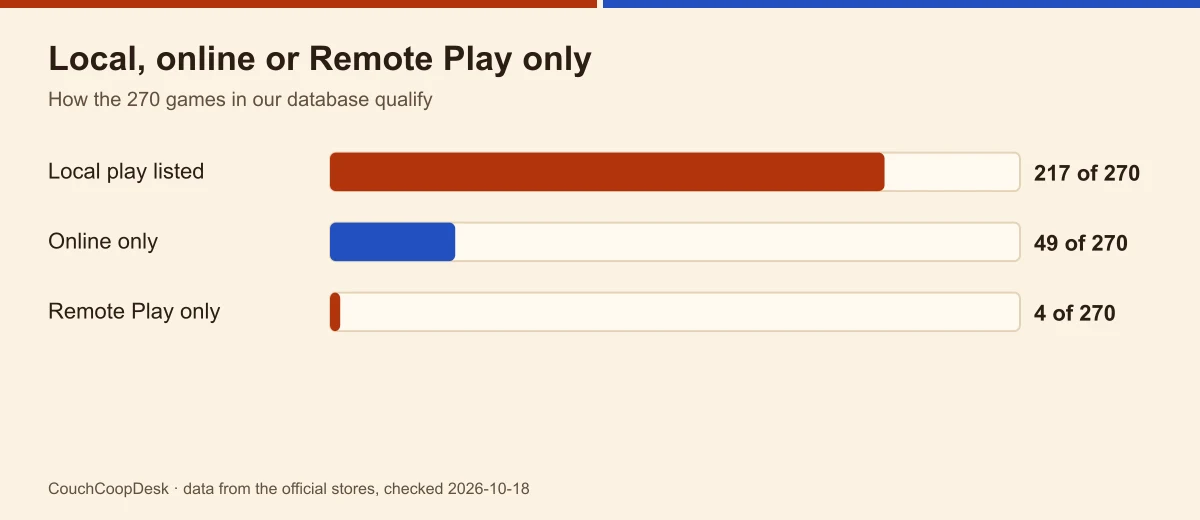 Chart: CouchCoopDesk, data from the official stores, checked Oct 18, 2026.
Most games in our database are couch games first: 217 of 270 list local play on some store. 49 are online only, and 4 get in only through Steam's Remote Play Together. For the online-only ones, two people in one room need two consoles, two copies and, on consoles, two memberships.
Crossplay is the online extra. 83 games in our data carry a crossplay label, 56 on the Microsoft Store and 57 on Steam, some on both. The crossplay co-op list keeps them together.
One copy, two players: the online exceptions
Four official features let a second player join online without buying the game. Each has limits, and none is the same as couch co-op.
| Feature | Who needs the game | Limit the official page states |
|---|---|---|
| Friend's Pass (EA) | One player | "One user must own the full game in order for the co-op player to play the full game" (Xbox listing, Split Fiction) |
| GameShare (Switch 2) | One player | Online, everyone needs an active Nintendo Switch Online membership |
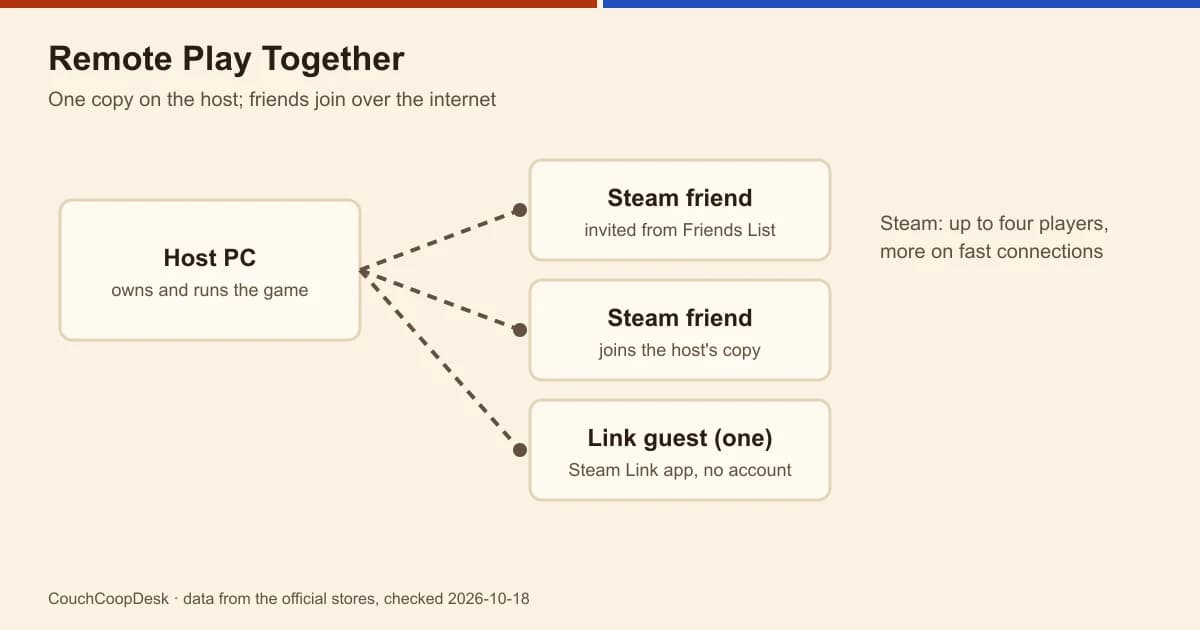
| Remote Play Together (Steam) | The host | Up to four players, "or even more with fast connections" |
| Share Play (PS5) | The host | One visitor at a time; a session ends one hour after the visitor joins |
EA says of Split Fiction: "As long as one of you owns the game, both of you can play!" Nintendo says GameShare means "only one person needs to have the game" in supported titles. PlayStation adds that both host and visitor need PlayStation Plus for Share Play. Steam's version is covered in the explainer linked under More Co-op Explainers below.
Analysis
The data says one thing clearly: the screen label is the weakest field in co-op shopping. 163 games carry a label that covers two setups. 140 of those have no written answer anywhere we read.
The player count is stronger. Xbox separates "local co-op" from local multiplayer, so it tells you whether the players cooperate.
Nintendo's Single system line tells you how many fit on one console. PlayStation's count tells you how many controllers the game accepts. None tells you how the TV is divided.
The gap is bigger on two platforms. On Switch and PS5 there is no screen field at all, so even the vague label is missing.
If a game's description does not say split-screen, the store has simply not said. That is not the same as "no split-screen". We do not guess.
How should you read a game page? Look at three things in this order:
- The one-console count for the console you own: Nintendo's Single system line, Xbox local co-op, the PlayStation player count.
- The screen wording in the description or on the publisher page, if any.
- The online line, and whether it needs a membership, for the nights when the second player is at home.
The finder on our site filters by the first and, where a store or publisher printed it, the second. Its split and shared screen filter only matches games with written evidence.
What players say
A comment in r/localmultiplayergames from 2026 puts the small-corner problem in numbers: "yeah if you do split screen that can only go up to 4 at most, and even that's tricky if you can't see around you. really it's only for 2." Another in the same thread disagrees on PC: "On PC with ultrawide 4 way split screen (or 3 vertical split screens) can still be a very nice experience."
One r/couchcoop comment from 2026 is a reminder that the screen is not everything: "partner and I use single players as couch coop all the time by both contributing and switching off who is holding the controller".
Video: Electronic Arts on YouTube (official), embedded.
Our take
Pick by the one-console count first, then look for the word split-screen on the store or publisher page. 163 games carry a Shared/split screen label, and 140 of them never say which kind. Only 24 of 270 name split-screen in their own text.
If you play online most nights, ignore the screen question and check the membership line instead. We re-read the store labels with every weekly data refresh, and this explainer gets a fresh check every 30 days.
What we don't know yet
For most games, how the screen is drawn. Xbox and Steam use one label for both setups; Nintendo and PlayStation print no field. We have not yet collected publisher pages for every game with the label, so the split and shared screen filter covers only games with written evidence.
More Co-op Explainers
- Steam Remote Play Together Explained: One Copy, 127 Games: how the host streams a local game, and which games carry it.
- Split-screen games: the 24 games whose store text says split-screen.
- Platform comparison: how often each store prints each field.
How we checked this
Store labels, player counts and description wording come from the Microsoft Store catalog, nintendo.com product pages, PlayStation Store pages and Steam's store data, read by our importer on Oct 18 and kept in our database. Our importer keeps only the fact that a description uses a word such as split-screen, not the text.
Steam data was read on a server where Steam resolves. Membership and controller rules come from PlayStation, Xbox and Nintendo support and product pages; game rules from EA's pages. Reddit comments were read through the Arctic Shift archive.
Frequently Asked Questions
What does Shared/split screen mean on the Xbox store? It is one capability label for two setups: a TV divided into a view per player, or one view every player shares. The Xbox store does not say which one a game uses. In our database, 67 of the 154 Xbox games we track carry the label, and most of them never say which kind.
Is local wireless on Switch the same as split-screen? No. Nintendo's Local wireless line counts players who each have their own console in the same room. The Single system line is the count for one console and one screen. Nintendo prints the two lines separately, and a game can list different numbers on each, so read Single system for a sofa.
Do you need PS Plus or Game Pass for split-screen? Not for two players on one console in most games, because the memberships are tied to online play. PlayStation says most PS4 and PS5 games need PlayStation Plus for online multiplayer, and Xbox says online console multiplayer requires Game Pass. Some games mix local and online, so check the store page.
Can two people play online co-op with one copy of a game? Sometimes. EA's Friend's Pass lets a second player join It Takes Two or Split Fiction without owning it. Switch 2 GameShare lets one owner share supported games. Steam Remote Play Together streams a local game from the one player who owns it. Each has its own limits.
Which games say split-screen in the store description? In our database, 24 of the 270 games have a store description that uses the word split-screen, among them Split Fiction, Minecraft, Halo: The Master Chief Collection and Dirt 5. Our split-screen games list keeps the current set, with the store that printed the word, and updates with the stores.
Does Nintendo show whether a Switch game is split-screen? Not in a field. Nintendo's No. of players field has three lines, Single system, Local wireless and Online, and none of them describes the screen. Only a game's own description can say split-screen, and in our data only a few Nintendo listings do, such as Hyrule Warriors: Age of Imprisonment.
Related Reading
- Split-screen shooters: shooters with split-screen in the store text or the store label.
- Couch co-op games under $20: one-console games by lowest regular price.
- How the database works: where every field comes from, and when it was checked.
References
- Xbox, Split Fiction listing (Shared/split screen, local and online co-op, Friend's Pass footnote): https://www.xbox.com/en-US/games/store/split-fiction/9n1wxxd1rl8d
- Xbox, free-to-play games: https://www.xbox.com/en-US/games/free-to-play
- Xbox, backward compatibility (online console multiplayer requires Game Pass): https://www.xbox.com/en-us/games/backward-compatibility
- PlayStation Support, PlayStation Plus: https://www.playstation.com/en-us/support/subscriptions/playstation-plus-support/
- PlayStation Support, PS5 accessories: https://www.playstation.com/en-us/support/hardware/accessories/
- PlayStation Support, PS5 Share Play: https://www.playstation.com/en-us/support/games/ps5-share-play/
- Nintendo, Nintendo Switch Online: https://www.nintendo.com/us/online/
- Nintendo, GameShare explainer: https://www.nintendo.com/us/whatsnew/learn-all-about-how-you-can-share-compatible-games-with-your-friends/
- Nintendo of America support, Controller pairing on Nintendo Switch 2 FAQ: https://en-americas-support.nintendo.com/app/answers/detail/a_id/68211/
- EA, Split Fiction features and Friend's Pass: https://www.ea.com/games/split-fiction/split-fiction/features/friends-pass
- EA, It Takes Two FAQ: https://www.ea.com/games/it-takes-two/it-takes-two/faq
- Steam, Remote Play (via Wayback, snapshot 20261010113511): https://web.archive.org/web/20261010113511/https://store.steampowered.com/remoteplay
Ask the desk: not sure a game works for your couch? Email contact@couchcoopdesk.com. We answer in the article FAQ with the date, not by private reply (how it works).
About the author

Editorial desk
The CouchCoopDesk desk. We read the Xbox, Nintendo, PlayStation and Steam store listings field by field, keep our own co-op database with a check date on every field, and say plainly when a store does not tell. We don't review games we haven't played.
Keep reading
Steam Remote Play Together Explained: One Copy, 127 Games
Co-op Explained · 12 min

Co-op Games for Different Skill Levels: How to Pick One
Play Together · 14 min
Co-Op Games to Play With Kids: 120 Rated E or E10+
Play Together · 12 min

Couch Co-Op Games for Couples: 49 That Stop at Two Players
Play Together · 11 min
Switch 2 Local Co-Op Games: 37 Games for Two on One Console
Platform Picks · 11 min
Best Couch Co-Op Games by Platform: 25 Picks, 5 Stores
Platform Picks · 20 min
Disclaimer
Player counts, split-screen labels, ESRB ratings and prices come from the official Xbox, Nintendo, PlayStation and Steam store pages as listed on the day we checked. Stores update them, and the same game can differ by console. Check the store's own page before you buy.
Articles are researched and written with AI tools, and every fact is checked against its source before publishing (see How we use AI). Corrections are made in the article with a dated PATCH line.
CouchCoopDesk is an independent fan resource, not affiliated with Sony, Microsoft, Nintendo, Valve or any publisher we mention. The site carries no ads, no affiliate links and no sponsored content (see Independence).